
Frequently Asked Questions
What are the fees for Guardian Bitcoin’s service?
- Guardian assisted wallet subscription
- Assistance with creating, validating, and co-signing transactions
- Inheritance plan setup
- Annual review with beneficiaries and/or trustee (optional)
- Inheritance claiming assistance for beneficiaries
- Quarterly Client Reviews
- Verify the health of your bitcoin wallet and keys
- Review your inheritance plan and modify as needed
- Transfer recent bitcoin purchases to self-custody wallet
- Review your buying strategy
- Share noteworthy industry news and developments
- Answer any questions you may have
One Time Onboarding – $500.00
- Concierge onboarding assistance
- Meet your Guardian
- Open your bitcoin exchange account
- Private bitcoin buying experience
- Dollar Cost Averaging setup
- Initialize signing devices
- Wallet setup and configuration
- Welcome kit
- Bitcoin Multi-Signature Wallet app
- Wallet signing devices (Client Key, Inheritance Key)
- Signing device protection sleeves
- Complimentary book to start kick start your Bitcoin education
- A collection of Guardian merchandise!
What is bitcoin?
Bitcoin is a decentralized digital currency that was invented in 2008 by an unknown person or group of people using the pseudonym Satoshi Nakamoto. Unlike traditional fiat currencies issued by governments (such as the US dollar or the Euro), Bitcoin operates on a global decentralized network of computers. Bitcoin transactions are peer-to-peer, between the sender and the receiver, so there is never a third-party or middle-man in between. This means that no single entity, like a central bank, controls the currency or its monetary policy. Bitcoin is open source software regulated by a set of protocol rules, there is no CEO, no board of directors, no bankers, or politicians; it is quite simply “rules without rulers”.
Where did bitcoin come from?
The idea of digital currency and cryptographic forms of money had been floating around long before Bitcoin. Researchers had proposed various forms of electronic cash, and several attempts were made to create digital currencies, but they often faced challenges related to centralization and double-spending. In October 2008 during the Great Financial Crisis, an individual or group using the pseudonym Satoshi Nakamoto released a white paper titled “Bitcoin: A Peer-to-Peer Electronic Cash System.” This paper laid out the conceptual and technical details of a payment system that would allow individuals to send and receive payments without involving any intermediaries.
Why does bitcoin have value?
Bitcoin’s value is derived from a combination of factors, some of which are intrinsic to its design and others that are based on external market factors.
Decentralization: Bitcoin operates on a global decentralized network of computers. This means that no single entity, government, or organization has control over the entire network. This decentralization reduces the risk of censorship, fraud, and manipulation.
Limited Supply: Bitcoin has a maximum supply capped at 21 million coins. This absolute scarcity is built into the code of Bitcoin itself and cannot be changed. The capped supply in contrast to potentially infinite fiat currency printing by central banks makes it a deflationary asset by design.
Security: Bitcoin’s blockchain is considered highly secure due to its proof-of-work consensus mechanism. The network’s security is maintained by miners who use computational power to validate and add transactions to the Bitcoin blockchain.
Portability: Bitcoins can be sent and received anywhere in the world, and transactions can be completed faster than traditional banking systems or remittance services.
Divisibility: Each Bitcoin can be divided into 100 million smaller units called satoshis. This divisibility ensures that even if the value of a single Bitcoin becomes very high, it can still be used for micro-transactions.
Sovereignty: Bitcoin allows users to have full control over their money without the need for intermediaries like banks. This is especially valuable in regions with unstable currencies or where the populace doesn’t trust local financial institutions.
Store of Value: Some view Bitcoin as “digital gold” — a store of value in the digital age. Just as gold has been used historically to hedge against inflation or economic instability, Bitcoin serves a similar purpose without all of the limitations of a physical asset like gold.
What is the bitcoin halving?
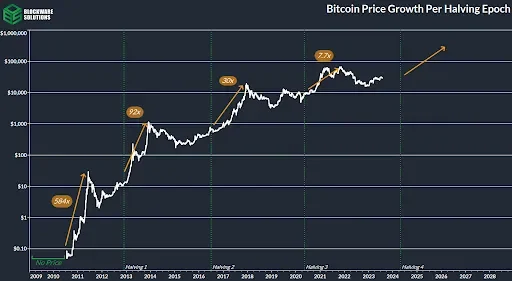
Central Banks around the world attempt to manage inflation and full employment by manipulating the supply of money leading to the boom and bust cycles in the economy. Bitcoin on the other hand has a fixed monetary supply, hard coded into the protocol. No Central Banker or politician can intervene. Bitcoin blocks are created approximately every 10 minutes and after every 210,00 blocks (approximately 4 years) the amount of new bitcoin issued per new block, the block reward, is cut in half. The third and most recent halving, on May 11, 2020, took Bitcoin’s issuance down from 12.5 BTC to 6.25 BTC every block. Prior to this, the second halving took place on July 9, 2016, reducing the mining reward from 25 BTC to 12.5 BTC. On November 28, 2012, Bitcoin’s initial block reward of 50 BTC was cut in half in the first-ever halving. This process will continue every four years until sometime in the year 2140, when the 34th halving will take Bitcoin’s final block reward from 0.00000001 BTC to 0.
You can track bitcoin’s halving countdown here.
This unique feature of bitcoin’s monetary policy makes bitcoin 100% in-elastic to demand! In contrast, when the price of gold goes up, gold miners are incentivized to ramp up production which eventually drives the price back down due to the growth in supply. This is one explanation for why bitcoin tends to increase in price, often dramatically, after each halving.
How do I acquire bitcoin?
Acquiring Bitcoin can be done in several ways. Some of the most common methods include:
Buying Bitcoin on an Exchange
- This is the most common method but, beware not all exchanges are created equal.
- With over 10 years of experience in bitcoin, Guardian has tried many of the well known exchanges. Guardian selected River as our partner based upon our shared values, a client-first Bitcoin only firm committed to empowering the long term investor.
Using a Bitcoin ATM
- Locate a Bitcoin ATM near you using services like CoinATMRadar.
Peer-to-Peer Trading
- Services like Paxful allow you to find individuals who are selling Bitcoin.
Mining Bitcoin
- Mining is highly competitive and might not be profitable for most individuals without access to cheap electricity and specialized equipment.
Accept Bitcoin as Payment
- If you run a business, you can start accepting Bitcoin as a method of payment using services like BitPay or BTCPay Server.
Do I have to buy a “whole” bitcoin?
Absolutely not! You can purchase as little as 1$ worth of bitcoin or millions of dollars worth of bitcoin, it’s up to you!
One of the paradoxes of bitcoin is its absolute scarcity, capped at 21 million coins, and its concurrent abundance. Each whole bitcoin can be divided into smaller units, up to 8 decimal places. The smallest bitcoin unit, .00000001, is called a Satoshi in honor of bitcoin’s creator – Satoshi Nakamoto.
“Unit bias” often prevents people from investing in bitcoin. Unit bias refers to the tendency of people to like the idea of owning a “whole” unit of something rather than a fraction, even though fractional ownership is entirely common and practical in the world of cryptocurrencies.
Bitcoin’s high per-unit price can make it seem “expensive” to some new investors, even though it’s possible to buy a fraction of a Bitcoin (like 0.001 BTC). On the other hand, a lesser-known or inexpensive cryptocurrency might be priced at less than $1 per coin, making it seem “cheap” and attractive to buy in whole units, even if the project behind it is less established or has a larger or unlimited circulating supply that justifies its lower per-unit price.
Unit bias can lead investors to make decisions based on the nominal price of a coin rather than its market capitalization, potential for growth, utility, or other more relevant factors. Don’t make this mistake!
I already own some bitcoin. Can I move it to a Guardian wallet?
Yes! Congratulations for already taking the first step and acquiring bitcoin! Many people start their bitcoin journey by buying bitcoin and leaving it with a 3rd party custodian, typically a crypto exchange. Guardian will assist you with transferring your bitcoin into your new Guardian assisted multisig wallet. We also help clients who currently have their bitcoin on a single key self-custody wallet of their own but, want to enhance the security and functionality (i.e. Inheritance Plan) by moving to a multisig wallet.
Why should I self-custody my bitcoin rather than leave it on an exchange?
Self-custodying your bitcoin refers to the act of personally holding and managing the private keys to your bitcoin wallet, as opposed to letting a third-party service or custodian do so on your behalf. Here are some reasons why you should self-custody:
- Sovereignty and Control: You have complete control over your bitcoin. No third party can freeze, confiscate, or control your funds without access to your private keys.
- Counterparty Risk Avoidance: When you keep your Bitcoin on an exchange or with a custodian, you’re taking on counterparty risk. This means you’re relying on that third party to be secure, solvent, and trustworthy. There have been numerous cases in the past where exchanges were hacked, or they shut down, leading to loss of customer funds. Just ask the customers of FTX or Celsius or Mt. Gox!
- Privacy: Self-custody offers more privacy. When using third-party services, your transactions and balances may be logged, monitored, or even reported, depending on regulatory requirements. With self-custody, your financial business remains your own.
- Regulatory Resilience: Over time, regulations can change. By self-custodying, you’re ensuring that you have access to your bitcoin no matter how regulations might shift. During the great depression in 1933, the US government effectively seized all gold bullion and coins via Franklin D Roosevelt’s Executive Order 6102, forcing citizens to sell at prices significantly below market rates.
- Fulfillment of Bitcoin’s Core Philosophy: One of Bitcoin’s underlying philosophies is to provide a decentralized currency, free from central control. By self-custodying, you are fully embracing this ethos, taking back control from centralized financial systems. By leaving your bitcoin on an exchange you are negating one of bitcoin’s most important features.
What is the difference between a custodial and a non-custodial wallet?
The primary difference between the two alternatives is who is in control of the wallet’s private keys. As the name suggests, a custodial wallet will have a service provider (typically an exchange) in possession and control of your wallet’s private keys. Because you are not in control of your keys, there is a risk that the service provider could be hacked, go bankrupt, or act maliciously, resulting in the loss of your bitcoin. Hence the saying in the bitcoin community, “Not your keys, not your coins”. Custodial wallets also present privacy, surveillance, and regulatory exposure. Guardian’s services are based exclusively upon non-custodial wallets. We collaborate with our clients to assist them with managing their wallet, keys, and inheritance plans. Our aim is captured in our tagline, “Self-Custody Made Simple”.
Is Guardian Bitcoin the custodian storing my bitcoin?
No. Guardian Bitcoin’s services are based upon a collaborative multsig wallet configuration. This is a self-custody solution, where the client is the custodian and is always 100% in control of their wallet and its assets. Guardian’s role is to assist our clients in securing and managing their wallet. There is no trusted third party risk. Only the client can initiate a transaction in the wallet, Guardian can only act as a transaction co-signer at the client’s request.
Which cryptocurrencies can I store in my Guardian self-custody wallet?
We are proud to be a bitcoin only firm. We believe that only Bitcoin has the properties required to fix our broken monetary system and change the world for the better.
If I self-custody my bitcoin, how do I pass it on to my heirs?
This is an important consideration and one that is often overlooked. As the custodian of your bitcoin assets, it becomes your responsibility to implement your inheritance plan. Guardian Bitcoin removes all of the complexity and makes it simple to set up an automated process to ensure your beneficiaries are taken care of according to your wishes. Guardian will assist your designated beneficiaries or trustee through the entire inheritance claiming process. We will also include a review of your inheritance plan during our quarterly client review meetings. Optionally, we will conduct an annual review with you and your beneficiaries at your request. Please see our Inheritance Plan description for details.
What is a multi-signature (a.k.a multisig) wallet?
A multi-signature wallet, often abbreviated as “multisig”, is a type of digital wallet that requires multiple private keys to authorize a transaction. This is in contrast to standard wallets that require only a single private key. The single key configuration represents a single point of failure. If the single private key is compromised all of the wallet’s bitcoin may be lost or stolen. Multi-signature wallets are designed to add an additional layer of security and redundancy and are the best option for securing bitcoin.
Here’s how it generally works:
- Setup: When the wallet is set up, you decide on the total number of signatures (private keys) that can be created and how many of them are required to authorize a transaction. This is often denoted as “M-of-N”, where M is the number of required signatures, and N is the total number of possible signatures. For example, a 2-of-4 multisig wallet means that there are 4 private keys in total, but only 2 are needed to authorize a transaction.
- Security: The primary advantage of a multisig wallet is enhanced security. Even if one of the private keys is compromised, an attacker cannot access the funds without the other necessary keys.
- Control and Access: Multisig wallets can be useful for business or organizational settings. For instance, a company might set up a multisig wallet for its treasury, requiring multiple executives to approve a large transaction, ensuring that no single person has full control over the funds.
- Recovery: In the context of personal use, multisig is a way to prevent loss of assets if one key is lost or stolen. For instance, in a 2-of-4 setup, even if you lose one key, you can still access your funds with the other two.
What is a collaborative multi-signature wallet?
Multisig wallets make use of a M of N signing quorum in order to authorize a transaction. A single person or entity can possess and control each of the private keys in the quorum. A Collaborative Multisig wallet is a variation in which one or more people hold a private key in the quorum and the parties work together to manage the wallet and collaborate to sign and approve transactions. This is precisely what Guardian Bitcoin’s service is built upon. We eliminate the complexity of wallet creation and management for our clients, while also providing enhanced security and redundancy by holding one of the keys (the Advisor Key) in our client’s wallet. Guardian can never initiate a transaction, only the client can initiate a transaction. However, Guardian will assist our clients as collaborators by staging, reviewing, and co-signing transactions.
Can I hold bitcoin in my IRA?
Yes, you can hold bitcoin in a self-directed IRA. You can even self-custody the bitcoin in your IRA rather than trusting a 3rd party custodian and exposing yourself to counterparty risk. Schedule a consultation and a Guardian Bitcoin representative will walk you through the process to set up and fund your IRA.
What are transaction signing devices (keys)?
A signing device is a physical electronic device designed specifically to store and protect an individual’s bitcoin private keys from potential threats such as viruses, hacks, and unauthorized access. By keeping the private keys in a secure hardware device, the keys never come into contact with internet-connected devices, making it much more difficult for online attackers to access or steal the funds.
You may hear people refer to a signing device as a “hardware wallet”. This term was popular prior to the emergence of Multisig Wallets, when most wallets were single signature (key) configurations.
How is bitcoin treated by the IRS for tax purposes?
While the term “cryptocurrency” is often used to describe bitcoin and other digital tokens, the IRS views bitcoin as property, not a currency. Selling bitcoin generates a taxable event, either a capital gain or loss depending upon your cost basis. However, bitcoin that is earned as compensation for goods and services, interest, or from bitcoin mining is taxed as ordinary income. More detailed information may be found in IRS Notice 2014-21.
Notice: Guardian Bitcoin does not provide tax, legal, investment, or financial advice. This information is general in nature and should not be relied upon for tax advice. We encourage you to consult the appropriate tax professional to understand your personal tax circumstances.
What if something catastrophic happens to Guardian Bitcoin or their wallet partner Nunchuk?
Another benefit of using an assisted self-custody service like Guardian Bitcoin is that even if something catastrophic were to happen to Guardian and/or Nunchuk, your wallet and bitcoins are still safe. Nunchuk was developed using open standards and tools. That means that a wallet created using the Nunchuk platform can be easily recovered by our clients. Please see this guide for a step by step walkthrough of how to recover your multisig wallet – Wallet Recovery Guide.
What is the block reward?
This reward (in the form of new bitcoin) is given to the miner that successfully mines a new block and adds it to the Bitcoin blockchain. These blocks are how bitcoin transactions are sent and stored. The block reward both compensates the miners for their efforts and serves as the control mechanism for issuing new bitcoins. Bitcoin’s monetary supply issuance is governed by a mechanism in the protocol that reduces the block reward by half approximately every 4 years. See “What is the bitcoin halving?”